Quick answer
A good medication list includes every prescription, over-the-counter medicine, vitamin and supplement you take. For each one, write the name, the strength, what it is for, and when, how and how much you take. Add your allergies and emergency contacts. Update it whenever anything changes, keep a copy with you, and share it with a trusted person who might speak for you in an emergency.
At almost every medical visit, hospital admission or pharmacy consultation, someone will ask, “What medications do you take?” It sounds simple. But many people take several medicines prescribed by different clinicians, plus over-the-counter products and supplements. Remembering every name and dose on the spot, especially when you are in pain or tired, is hard. A written medication list solves that problem. The U.S. Food and Drug Administration (FDA) recommends that everyone keep one.
Why care teams ask for your list
- To avoid dangerous interactions. Some medicines, and some supplements, affect how others work.
- To prevent duplicates. The same drug can be sold under different brand and generic names.
- To make safe decisions quickly. In an emergency, responders and hospital staff need to know what you take and what you are allergic to.
- To keep everyone on the same page. Your cardiologist, primary care provider, surgeon and pharmacist may each see only part of the picture.
The FDA notes that a list also helps people communicate important information when they are in pain or tired, or when English is not their first language.
What to include
Based on FDA guidance, list each of these:
| Include | Examples |
|---|---|
| Prescription medicines | Pills, inhalers, injections, patches, eye drops, creams |
| Over-the-counter medicines | Pain relievers, antacids, allergy and sleep aids |
| Vitamins and supplements | Multivitamins, fish oil, herbal products |
| Allergies | Medicine, food or latex allergies, and what reaction you had |
| Emergency contacts | Name and phone number of someone who can speak for you |
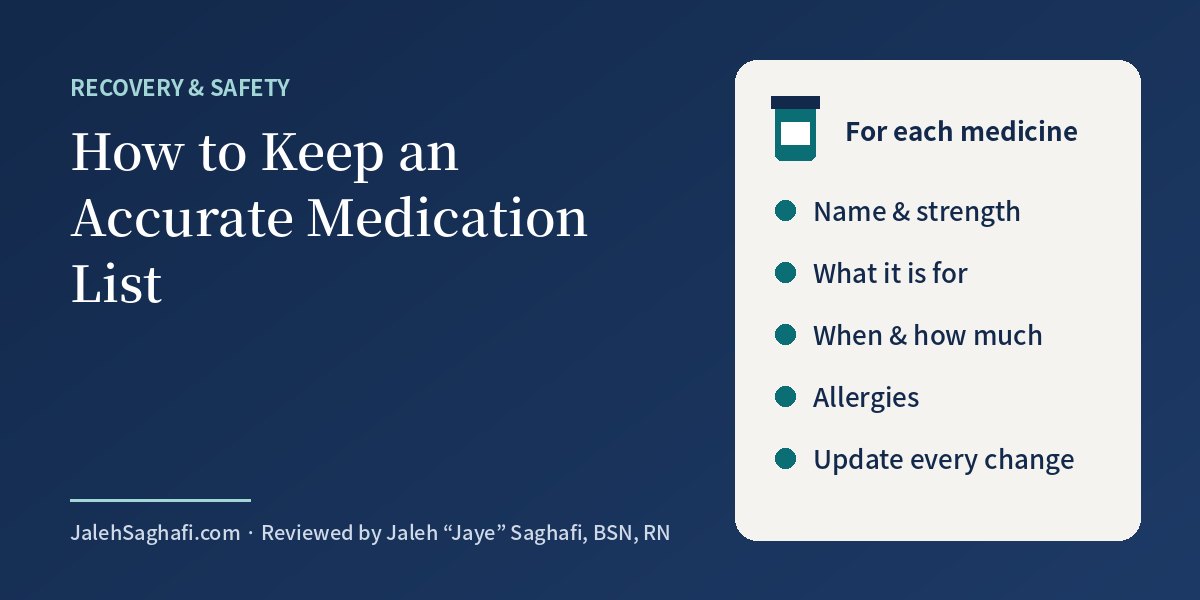
For every medicine, write down
- The name (brand and generic, if you know both)
- The strength (for example, 25 mg)
- What it is for (for example, blood pressure)
- When, how and how much you take (for example, one tablet by mouth every morning)
It also helps to note who prescribed it and the date you started, especially for heart medicines that are adjusted over time.
A simple format you can copy
| Medicine and strength | What it’s for | How and when | Prescriber |
|---|---|---|---|
| Example: Medicine A, 10 mg | Blood pressure | 1 tablet each morning | Dr. Name |
Keep it current
The FDA advises reviewing and updating your list often, especially when something changes. Update it when you:
- Start a new prescription
- Have a dose changed
- Stop a medicine
- Start or stop a vitamin or supplement
- Leave the hospital or a surgery center with new instructions
Keep it with you, and share it
- Carry a current copy. This can be a paper copy kept with your insurance card, a photo on your phone, or an entry in an app.
- Share a copy with a trusted family member, friend or caregiver, especially anyone who goes to appointments with you or might speak for you in an emergency.
- Bring the list, or the medicines themselves, to every appointment. The Agency for Healthcare Research and Quality suggests bringing all your medicines, including non-prescription ones, vitamins and supplements.
Questions to ask about each new medicine
- What is it for, and how will I know it is working?
- When exactly should I take it, and with or without food?
- What side effects should I watch for, and which ones should I report?
- Is it safe with everything else on my list?
For more questions to bring to a visit, see how to prepare for a cardiology appointment.
Explaining medications is a constant part of nursing. Jaleh “Jaye” Saghafi, BSN, RN, has educated patients and families about medications in cardiovascular, surgical, perioperative and infusion settings. Read about her clinical and patient education experience.
Sources
- U.S. Food and Drug Administration, Create and Keep a Medication List for Your Health
- Agency for Healthcare Research and Quality, Be More Engaged in Your Healthcare