Quick answer
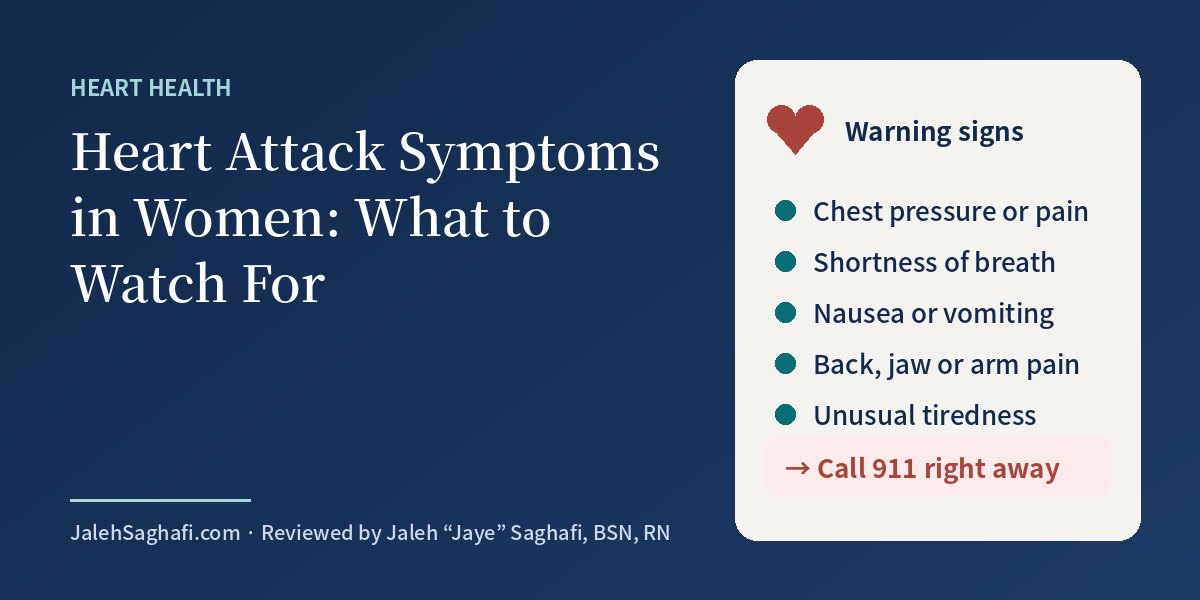
The most common heart attack symptom in women is the same as in men: chest pain or discomfort. It can feel like pressure, squeezing or fullness. Women are somewhat more likely than men to also have shortness of breath, nausea or vomiting, and back or jaw pain. If you or someone with you has these signs, call 911 right away. Do not drive yourself to the hospital.
If you think you are having a heart attack, stop reading and call 911 now.
Many people picture a heart attack as sudden, crushing chest pain. That does happen, but the American Heart Association notes that many heart attacks start slowly, with mild pain or discomfort. Women in particular may have symptoms that are easy to mistake for the flu, indigestion, stress or ordinary tiredness. Knowing the full range of warning signs helps you act sooner. With a heart attack, acting sooner can save heart muscle and lives.
The warning signs of a heart attack
The American Heart Association lists these as the main warning signs for everyone:
- Chest discomfort. Uncomfortable pressure, squeezing, fullness or pain in the center of the chest. It may last more than a few minutes, or go away and come back.
- Discomfort in other parts of the upper body. Pain or discomfort in one or both arms, the back, neck, jaw or stomach.
- Shortness of breath, with or without chest discomfort.
- Other signs, such as breaking out in a cold sweat, nausea or lightheadedness.
Symptoms that are more common in women
Chest pain or discomfort is still the most common symptom in women. But according to the American Heart Association, women are somewhat more likely than men to experience:
| Symptom | What it may feel like | What it is often mistaken for |
|---|---|---|
| Shortness of breath | Breathless with little or no activity | Being out of shape, anxiety |
| Nausea or vomiting | Upset stomach, sometimes with sweating | Stomach bug, food poisoning, indigestion |
| Back or jaw pain | Pressure or aching in the upper back, jaw or neck | Muscle strain, dental problems |
| Unusual tiredness and weakness | Exhaustion that is out of proportion to activity | Poor sleep, a busy week |
| Lightheadedness | Dizzy or faint | Dehydration, skipping a meal |
Some women describe upper back pressure that feels like squeezing, or like a rope being tied around them. The common thread is that these symptoms can feel vague. That is one reason women may wait longer to get help.
Why waiting is dangerous
During a heart attack, blood flow to part of the heart muscle is blocked. The longer the blockage lasts, the more heart muscle can be damaged. The American Heart Association advises calling 911 rather than driving to the hospital, for two reasons:
- Emergency medical services (EMS) crews can begin evaluating and treating you as soon as they arrive.
- If your heart stops on the way, trained responders with a defibrillator are with you.
If you are the one having symptoms, do not drive yourself unless you have absolutely no other option.
What to do, step by step
- Call 911 as soon as you notice warning signs, even if you are not sure. Being checked and told it is nothing is far better than waiting too long.
- Tell the dispatcher your symptoms and follow their instructions. Dispatchers are trained to guide callers through suspected heart attacks.
- Unlock the door and sit or lie down somewhere responders can reach you easily.
- Have your medication list ready if you can. Responders and hospital staff will want to know what you take and what you are allergic to. (See how to keep an accurate medication list.)
- If someone collapses and is not breathing normally, start CPR and have someone find an automated external defibrillator (AED), if one is available.
“I didn’t want to bother anyone”
Feeling embarrassed about a possible false alarm is understandable. So is not wanting to believe it could be your heart. Emergency teams would much rather see a patient who turns out to be fine than a patient who arrived too late. If something feels wrong, trust that feeling and make the call.
After the emergency: questions for your follow-up
If you have had a heart attack or a heart scare, your follow-up visits are a good time to ask about your risk factors, your new medications and next steps such as cardiac rehabilitation. These two guides can help:
Key takeaways
- Chest pain or discomfort is the most common heart attack symptom in women and men.
- Women are somewhat more likely to also have shortness of breath, nausea or vomiting, and back or jaw pain.
- Symptoms can be mild, can come and go, and can be mistaken for flu, indigestion or stress.
- Call 911 right away. Do not drive yourself.
This article was reviewed by Jaleh “Jaye” Saghafi, BSN, RN, who has worked in the Cardiovascular ICU and transplant unit at Cleveland Clinic and holds Advanced Cardiovascular Life Support (ACLS) certification. Read more about her cardiovascular nursing experience.
Sources
- American Heart Association, Heart Attack Symptoms in Women
- American Heart Association, Warning Signs of a Heart Attack